
A Small Bead Contains a Mountain and a River.
2026-06-05 20:00:00
A Small Bead Contains a Mountain and a River.
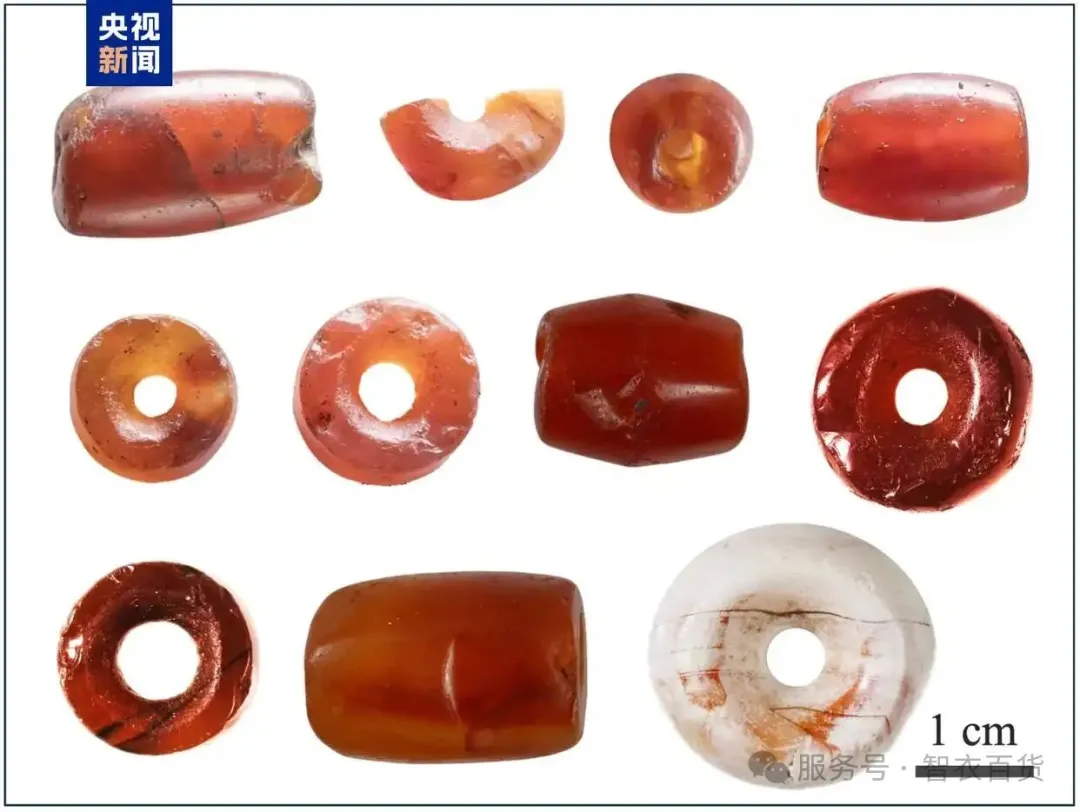
Eleven carnelian beads, no larger than the palm of your hand, appear tiny and insignificant among the magnificent bronze and gold artifacts of Sanxingdui. Yet, their warm, reddish-brown texture and the marks of three thousand years ago have redefined our understanding of the ancient Shu civilization. In June 2026, Sanxingdui, in collaboration with the Chinese Academy of Sciences, released its provenance research. These beads, found in sacrificial pits No. 2, 5, 7, and 8 (4, 1, 2, and 4 beads respectively), dating back approximately 3200 years (1200-1000 BC), have, through geological and chemical evidence, shattered the old notion of the ancient Shu civilization as an isolated island. They serve as invaluable material evidence of the diverse yet unified nature of Chinese civilization and the cross-regional trade and exchange in ancient times.
Carnelian, with its reddish-brown and lustrous texture, was already a rare treasure during the Shang and Zhou dynasties. The 11 beads were meticulously polished by hand, with drilled holes at both ends. The beads bear the marks of wear and tear from years of wear. In addition, they were unearthed in the same pit as high-level sacrificial objects such as ivory, gold ornaments, and bronze ritual vessels. This is enough to determine that they were exclusive tokens of the ancient Shu royal family and priestly class. They were worn by the powerful and nobles during their lifetime and were eventually buried in the sacrificial pit as sacred offerings, carrying the faith and status symbols of the ancient Shu people. Previously, the mainstream academic view held that ancient Chinese carnelian raw materials were mostly introduced via land routes from South Asia and West Asia, and the Sanxingdui beads were also classified as imported goods. However, this latest research, based on a trace element database constructed from 27 mining areas and over 300 ore samples, completely overturns previous conclusions: 7 out of 11 beads trace their origin to the Yanshan Orogenic Belt, thousands of miles away; 3 trace their origin to the Central Asian Orogenic Belt and the Hexi Corridor; only 1 bead remains unmatched in its mining area, and the raw material is neither from Sichuan nor from the Deccan Plateau in India or the Yunnan-Guizhou mining areas in southwestern my country.
The journey of raw materials from thousands of miles away to Sichuan is a concrete microcosm of a vast trade network in ancient China. From the Yanshan Mountains to Guanghan, Sichuan, a straight-line distance of over a thousand kilometers traverses the Loess Plateau, the Qinling Mountains, and the eastern edge of the Qinghai-Tibet Plateau. In the Shang and Zhou dynasties, before the advent of major trade routes and standardized trade paths, carnelian traveled south along the northern grasslands, the Hexi Corridor, and the ancient roads of northern Sichuan, connecting the civilizations of southern Mongolia, North China, the Central Plains, Northwest China, and the Sichuan Basin. Carnelian beads unearthed from contemporaneous sites in Shaanxi, Gansu, and Beijing show a high degree of mineral content matching with those found in the Sanxingdui collection, providing further evidence that a mature and stable inter-regional trade route had already taken shape: ancient Shu traded its local silk, gold, and Sichuan specialties northward in exchange for northern jade and mineral resources. Behind this flow of pearls and jade lay the exchange of goods and the fusion of customs among civilizations. For a long time, the bizarre and wondrous bronze human figures and sacred tree sculptures of Sanxingdui have been mistakenly interpreted as products of a foreign civilization isolated from the Central Plains. Eleven carnelian beads, however, scientifically prove that ancient Shu, surrounded by mountains, was never a closed-off region. From the Bronze Age onwards, it was a crucial link in the map of Chinese civilization's exchange, actively embedded in the nationwide resource circulation system.
These small beads are also a vivid footnote to the diverse yet unified pattern of Chinese civilization. Chinese civilization has never been a patchwork of isolated regional civilizations, but rather an organic whole that has continuously interacted and coexisted for thousands of years. The rituals and music of the Central Plains, the nomadic culture of the North, the ancient customs of Bashu, and the cultures of the northwestern ethnic minorities all permeated each other through the circulation of jade, minerals, and other products. The migration trajectory of carnelian from northern mines to sacred objects on ancient Shu altars reflects the trajectory of ancient Chinese civilization breaking down geographical barriers and deeply integrating with each other. The abundant presence of carnelian ornaments in Western Zhou aristocratic tombs, traced back to their connection to northern mining belts, fills a crucial gap in the transmission chain of Shang and Zhou jade ornament culture, clarifying the complete trajectory of carnelian ornaments' flow from north to south, transforming from aristocratic adornments to ritual symbols.
From a single mineral to a sacrificial bead, this journey across mountains and rivers embodies the indomitable spirit of exploration of ancient peoples. Three thousand years ago, merchants and tribal envoys traversed mountains and valleys, establishing early cultural connections through barter; three thousand years later, modern archaeology, relying on geochemistry and non-destructive testing techniques, deciphers the origin codes of these artifacts, allowing these silent ancient beads to speak of the open and inclusive history of early China.
Eleven carnelian beads, lacking the imposing grandeur of bronze artifacts, use their warm, crimson hue to outline the vast civilization of ancient China. It reminds the world that unity in diversity is deeply rooted in the genes of Chinese civilization; mountains and seas have never been barriers between civilizations, but rather long roads facilitating cultural exchange since ancient times.
Ancient texts describe a region with Mount Hua as its central axis, Yizhou to the east and Chuzhou to the west, forming the ancient name for China. This is the basis for Zhang Taiyan's naming of the Republic of China. Chuzhou is present-day Western Shu, or Sichuan. How can modern people not be amazed?!
A trip to Chengdu last September left me with this profound impression.
